2025: An inflation-watcher’s year in review

AI image. Source: Google Gemini

By David Enna, Tipswatch.com

Let’s all admit one thing: 2025 has been a bizarre year for the U.S. economy, inflation, government effectiveness and the certainty of economic statistics. In fact, my code word through the entire year has been “uncertainty,” so much so that some readers complained I use that word too often.

In this year:

  • President Trump launched an seemingly dangerous policy of high tariffs on U.S. imports, threatening friends and foes across the world. At first, the market reacted in fear, with the S&P 500 index falling nearly 5% on April 3, the day after “liberation day.”
  • But after a few pauses and restarts, the tariff policies seem to have been accepted by the markets. The S&P 500 has had a total return of 19.2% year-to-date. Euphoria over artificial intelligence has helped overcome the fears.
  • The Federal Reserve cut short-term interest rates three times in 2025, with the effective federal funds rate falling from about 4.32% in January to 3.64% this week.
  • But … the Fed’s rate cuts have had almost no effect in lowering longer-term interest rates. The yield on a 20-year Treasury bond has fallen just 10 basis points since January 1. The 30-year bond is actually up, now at 4.81% versus 4.79% on January 1.
  • Elon Musk breezed into Washington on a mission to cut government spending. He did cut jobs: Government payroll numbers are down about 9% this year.
  • But … Despite the cuts, government outlays have increased about 6% in 2025, according to studies by the Cato Institute and Brookings Institution.
  • The U.S. government shut down for 43 days because of Congress’s failure to pass budget bills or a continuing resolution. The shutdown (and continuing high deficit spending) has shaken confidence in the value of the U.S. dollar, which has fallen 10% this year.
  • But … The shutdown also eliminated or delayed reporting of many crucial economic statistics, including for inflation and jobs. Which means we are now in “a fog” as we head into 2026.

Inflation

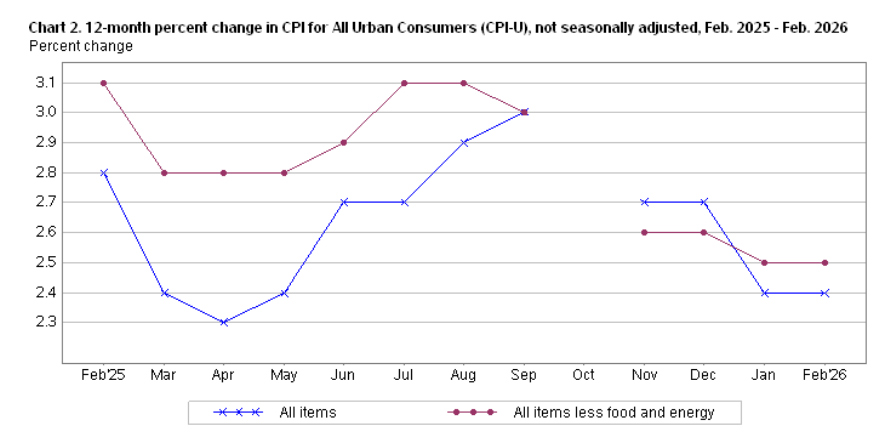
In November 2024, annual U.S. inflation stood at 2.7% for all-items and 3.3% for core. Today — if you want to believe the November 2025 inflation report — those numbers stand at 2.7% for all-items and 2.6% for core. That looks like an improvement for core inflation, but the number is skewed by the lack of October housing data.

This one chart — unique in the history of U.S. inflation reporting — says it all:

Inflation could truly be on a declining slope, but because of the lack of data we really can’t be sure. And this problem will most likely continue, and I will again get to use the word “uncertainty.”

Clearly, this is a problem for investors in Treasury Inflation-Protected Securities and Series I Savings Bonds, which have returns tied to official U.S. inflation. As the saying goes, “The devil is in the details.” Right now, we have no details. Good luck finding the devil.

Treasury Inflation-Protected Securities

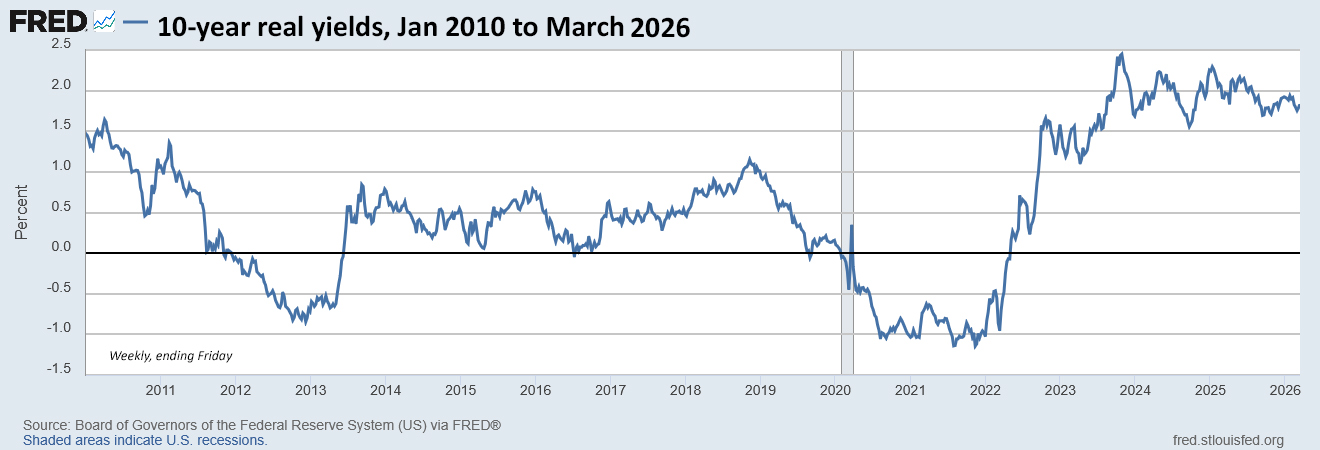
Real yields for longer-term TIPS have held up quite well throughout 2025, which is good news for people attempting to build a ladder of TIPS issues extending well into the future. You can still find real yields at 2.0% or higher — sometimes much higher — for maturities in 2040 to 2055.

Even the 10-year real yield remains attractive, now sitting at a still-appealing 1.90%, down from 2.23% on January 1.

Here is a look at the 12 TIPS auction through the year:

I have highlighted the highs and lows for the year, which don’t tell you much except that the yield curve has steepened, and that inflation expectations are higher in the short term but lower for the long term. Plus, note the big move higher for the 5-year TIPS after the October government shutdown and the resulting black hole of inflation data. TIPS yields are facing a “confidence tax.”

Compare that chart with the same summary for 2024:

Here is the key difference over the last year: The yield curve has steepened. In early 2024, the highest real yields were for 5-year TIPS. That trend reversed in 2025, mainly due to the Federal Reserve’s actions to lower short-term interest rates. Today, the highest auction yields are for 30-year TIPS, which I would say “is normal.”

Here is the trend line for the main TIPS categories over the last year, showing how the spread has widened for long-term versus shorter-term:

Click on image for larger version.

Overall, I’d say TIPS yields remain attractive, and that might be because the market doesn’t trust the inflation data coming now and into the near future. Plus, obviously, federal deficits will continue to rise. So investors are demanding higher real yields.

U.S. Series I Savings Bonds

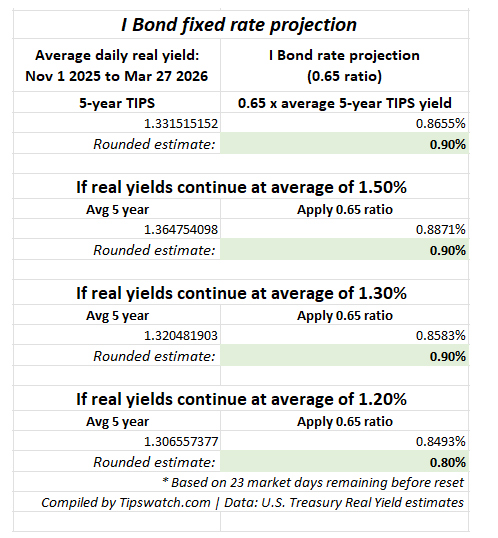
These inflation-protected savings bonds started the year with a fixed rate of 1.2% and a six-month composite rate of 3.11%. Today, the fixed rate for new purchases has fallen to 0.9%, but the composite rate has increased to 4.03%.

Am I still a fan of I Bonds? Sure. But at this point a 5-year TIPS with a real yield of about 1.44% is definitely a competitive investment. And the 10-year TIPS is even more attractive with a real yield of 1.90%.

The problem for all inflation-adjusted investments is trust in the U.S. statistical reporting system. The government shutdown threw a wrench into the November inflation rate, and that disruption could linger unless the Bureau of Labor Statistics finds a way to make adjustments.

I will be likely to purchase a 2026 allocation of I Bonds, but definitely not before mid-April when I can see where both the variable rate and fixed rates are trending.

In summary

I am getting tons of feedback from readers who no longer trust the system. Deficits are out of control. Official inflation reports are jumbled, which is probably being kind. I have no idea where we are heading. I will admit that. The stock market could soar … or plummet. Inflation could reignite … or move toward deflation. The labor market could remain solid … or jobs will disappear.

Unless we have a deep recession, I can’t see inflation lessening dramatically in 2026. But I know that trying to predict future inflation is impossible. So all I can say is:

Have a wonderful New Year. Let’s stick together and figure this out.

—————————

Donate? This site is free and I plan to keep it that way. Some readers have suggested having a way to contribute. I would welcome donations. Any amount, or skip it, your choice. This is completely optional.

PayPal link / Venmo link

—————————

Follow Tipswatch on X for updates on daily Treasury auctions and real yield trends (when I am not traveling).

Feel free to post comments or questions below. If it is your first-ever comment, it will have to wait for moderation. After that, your comments will automatically appear. Please stay on topic and avoid political tirades. NOTE: Comment threads can only be three responses deep. If you see that you cannot respond, create a new comment and reference the topic.

David Enna is a financial journalist, not a financial adviser. He is not selling or profiting from any investment discussed. I Bonds and TIPS are not “get rich” investments; they are best used for capital preservation and inflation protection. They can be purchased through the Treasury or other providers without fees, commissions or carrying charges. Please do your own research before investing.

Posted in Federal Reserve, I Bond, Inflation, Investing in TIPS, Retirement | Tagged , , , , | 21 Comments

What’s inside the foggy November inflation report?

By David Enna, Tipswatch.com

Since there were very few month-to-month price changes detailed in the November inflation report, we are all left wondering about key areas that resulted in surprisingly low inflation for the September to November period.

This CPI report by the Bureau of Labor Statistics has been highly criticized by economists and inflation experts. Headline and core inflation numbers rose by less than half the number predicted by experts, with all-items CPI rising 2.7% over the 12 months to November, and core up 2.6%.

The BLS produced little data on overall month-to-month inflation changes, but reported that CPI was up only 0.2% total in the two months of October and November. At a time when annual inflation was running at 3.0%, this appears to be cutting the inflation rate by more than half from an expected monthly rate of 0.25%.

However, a decline from 3.0% all-items inflation in September to 2.7% in November is not unusual. And in fact over the last 10 years, annual inflation rates have fallen half the time in that September to November period.

There has been widespread skepticism (including strongly from Tipswatch readers) about the validity of the November inflation report. From Bloomberg’s report:

In a report fouled by the record-long government shutdown, inflation in several categories that had long been stubborn seemed to nearly evaporate. Chief among those were shelter costs, which make up about a third of the consumer price index, but other categories like airfares and apparel notably declined. …

Stacey Standish, a spokesperson for BLS, said the agency used a process called carry-forward imputation for key housing price metrics. This method “imputes the price by using data from the last collected period, effectively proceeding as if the price had not changed,” she said. “Rents for October 2025 were carried forward from April 2025, yielding unchanged index values for rent and owners’ equivalent rent for October.”

OK, I am confused. Carry forward rent data from April 2025? Leading to zero increase in shelter costs in October? Can someone help me understand? From a Fortune report:

“This is a wacky number,” Diane Swonk, chief economist at KPMG, told Fortune. “Shelter costs basically flatlined October by carrying forward September. When housing is that large a component, that really matters.”

Housing appears to be the most distorted category. Shelter accounts for more than 40% of core CPI, yet the November report implies rents and owners’ equivalent rent was essentially zero in October.

“We expected it to cool,” Swonk said, “For this low level, it seems a little bit too much.”

She warned those assumptions don’t simply affect one month’s data. “Because of the assumptions that were made in October, it literally anchors the index going forward,” she said. “It lingers.”

More from Barron’s:

Cris de Ritis, deputy chief economist at Moody’s Analytics, said it’s best not to draw too much signal from the latest shelter data. He notes that market data on apartment rents have been weak, making the downward trend plausible. “It’s the magnitude we’ll want to examine with some caution,” de Ritis said.

“The CPI report definitely comes with an asterisk this month, given the carry-forward assumptions the BLS had to make,” de Ritis said. “It’s not unprecedented for disinflation to occur over a 2-month stretch in the history of the series, but it has been rare.”

Because we got no month-to-month data for October and November, I decided to look at look at changes in September to November annual price increases for major consumer categories. It’s about the only indication we have to determine — in theory — where inflation is declining or rising.

This chart suggest a strong trend of disinflation in the U.S. economy, with most areas outside of energy seeing declines in annual inflation rates. The decline in shelter to 3.0% was a huge factor in both the all-items and core inflation declines.

In an FAQ on its processes for this inflation report, the BLS gave a very foggy update on shelter calculations:

BLS calculates rent and owners’ equivalent rent using six-month panel collection. How will the missing October 2025 data impact the April 2026 rent and OER indexes?

BLS is researching how the missing October 2025 data for rent and OER will affect the 6-month change for April 2026 data.

One of the unique issues created by the government shutdown is that October inflation numbers simply don’t exist. For example, the BLS noted:

For some programs, products with missing data may be curtailed. For example, the CPI latest numbers page will be temporarily disabled, and the CPI inflation calculator will not calculate output using October 2025 data. … In the BLS Public Data API and the database, a dash will represent a missing data value, and associated net and percent changes will not be visible.

The end result, possibly, is that we will see lower annual inflation numbers going forward at least for several months, even if the monthly data are accurate. It will take some time to recover from “theoretical” 0.1% inflation for both October and November.

I have noted that I don’t believe that the BLS set out to please the White House by publishing low inflation numbers. But I do believe these statisticians now have reason to guess on the low side when they are estimating inflation, and this November report was full of guesses.

See: U.S. annual inflation falls to 2.7% for November, a surprising drop

—————————

Donate? This site is free and I plan to keep it that way. Some readers have suggested having a way to contribute. I would welcome donations. Any amount, or skip it, your choice. This is completely optional.

PayPal link / Venmo link

—————————

Follow Tipswatch on X for updates on daily Treasury auctions and real yield trends (when I am not traveling).

Feel free to post comments or questions below. If it is your first-ever comment, it will have to wait for moderation. After that, your comments will automatically appear. Please stay on topic and avoid political tirades. NOTE: Comment threads can only be three responses deep. If you see that you cannot respond, create a new comment and reference the topic.

David Enna is a financial journalist, not a financial adviser. He is not selling or profiting from any investment discussed. I Bonds and TIPS are not “get rich” investments; they are best used for capital preservation and inflation protection. They can be purchased through the Treasury or other providers without fees, commissions or carrying charges. Please do your own research before investing.

Posted in Inflation, Investing in TIPS | Tagged , , , , | 51 Comments

5-year TIPS reopening auction gets real yield of 1.433% to solid demand

By David Enna, Tipswatch.com

The Treasury’s offering of $24 billion in a reopened 5-year TIPS — CUSIP 91282CPH8 — generated a real yield to maturity of 1.433% to strong demand from investors.

The mild October/November inflation report, issued this morning, could have had some influence on this auction. This TIPS trades on the secondary market and earlier in the day it was trading with a real yield of 1.41%. The auction’s 1.433% resulted from its inflation-breakeven rate slipping lower. In addition, the November inflation index will trigger a 0.46% decline in January inflation accruals, so a higher real yield was justified.

The bid-to-cover ratio of 2.62 was solid, and the auction’s real yield ended up lower than the “when-issued” prediction of 1.4409%. All of that is an indication of positive investor demand.

Definition: The “real yield to maturity” of a TIPS is its yield above official future U.S. inflation, over the term of the TIPS. So a real yield of 1.433% means an investment in this TIPS would provide a return that exceeds U.S. inflation by 1.433% for its remaining term of 4 years, 10 months.

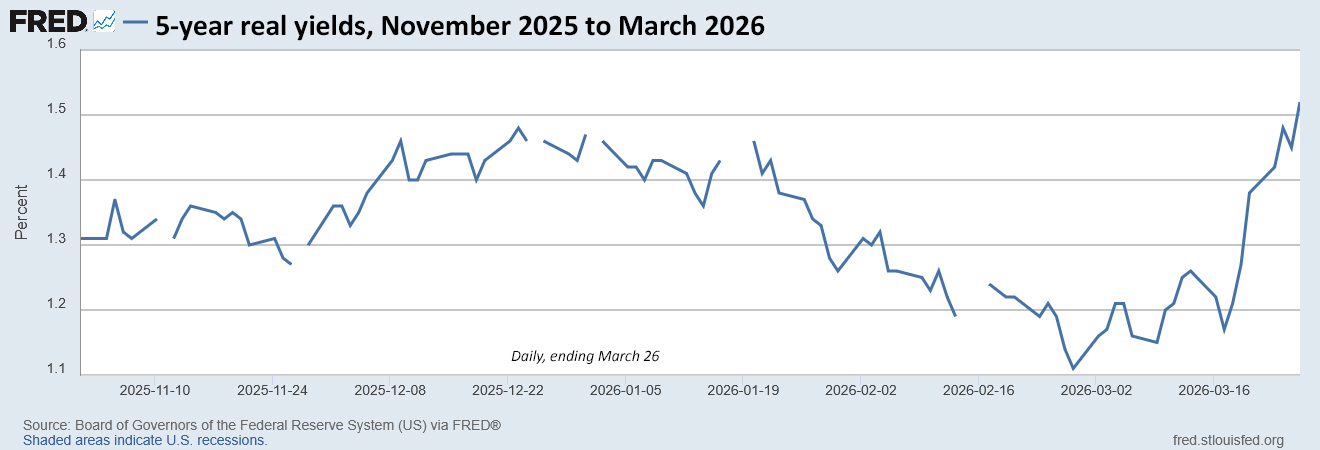
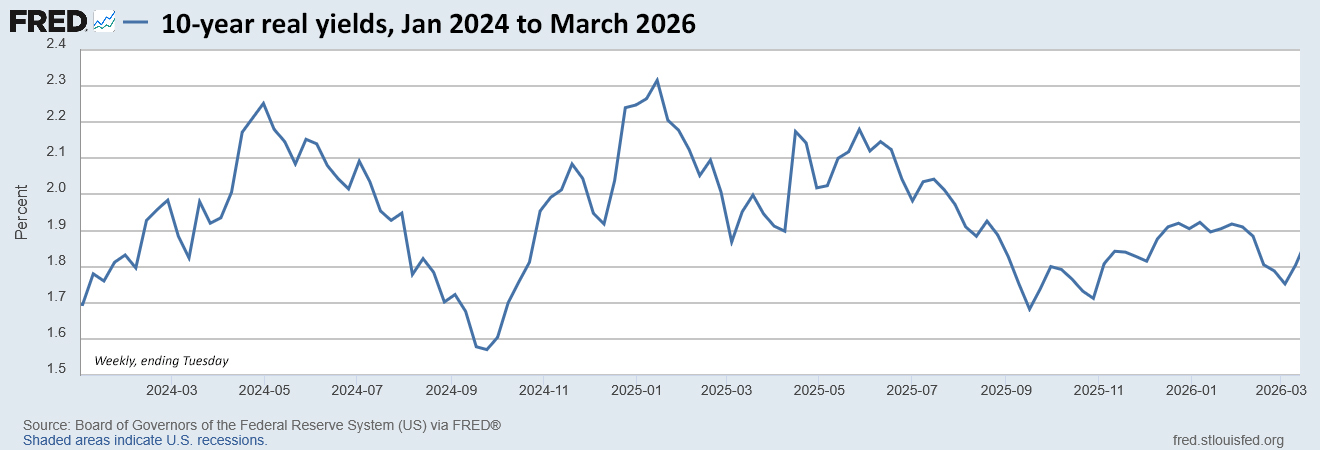
The 5-year real yield has been sliding lower over the last two years as the Federal Reserve signaled future cuts in short-term interest rates. But it has been rising recently, as shown in this chart:

Click on image for larger version.

Pricing

The auction’s unadjusted price was 98.578423, at a discount because the real yield was higher than the existing coupon rate of 1.125%. In addition, this TIPS will have an inflation index of 1.00653 on the settlement date of Dec. 31. With that information, we can calculate the cost of a $10,000 par value investment:

  • Par value. $10,000.
  • Principal purchased as of settlement date. $10,000 x 1.00653 = $10,065.30.
  • Cost of investment. $10,065.30 x 0.98578423 = $9,922.21.
  • + accrued interest of $23.95.

In summary, an investor purchasing $10,000 par value at this auction paid $9,922.21 for $10,065.30 of principal on the settlement date of Dec. 31. From then on, the investor will earn accruals matching future inflation plus an annual coupon rate of 1.125% paid on adjusted principal. The accrued interest will be returned at the first coupon payment on April 15.

Inflation breakeven rate

At the auction’s close, the 5-year Treasury note was trading with a nominal yield of 3.68%, which creates an inflation-breakeven rate of 2.25% for this TIPS, below recent trends. This means the TIPS will out-perform the nominal Treasury if inflation averages more than 2.25% over the next 4 years, 10 months. (Inflation over the last five years has averaged 4.5%.)

Here is the trend in the 5-year inflation breakeven rate over the last two years. Note that today’s result of 2.25% fell a bit below recent trends. The data for this chart was through Tuesday:

Click on image for larger version.

Thoughts

Despite the disruption of the very confusing November inflation report, this auction seemed to go off without a hitch. The resulting real yield of 1.433% was a bit higher than looked likely earlier in the week. Investors did fine.

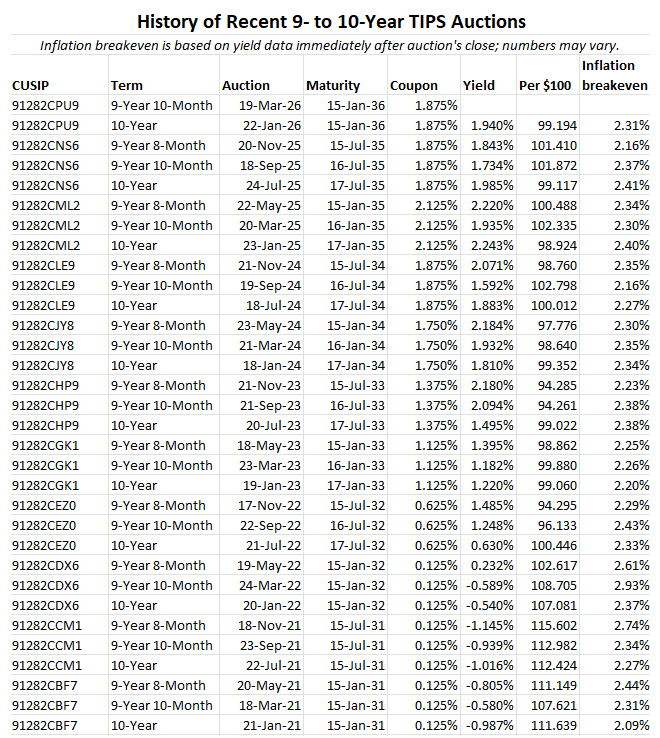
This is the last TIPS auction of 2025. Next up is a new 10-year TIPS to be auctioned January 22, 2026. This will be the first TIPS in history to mature in 2036.

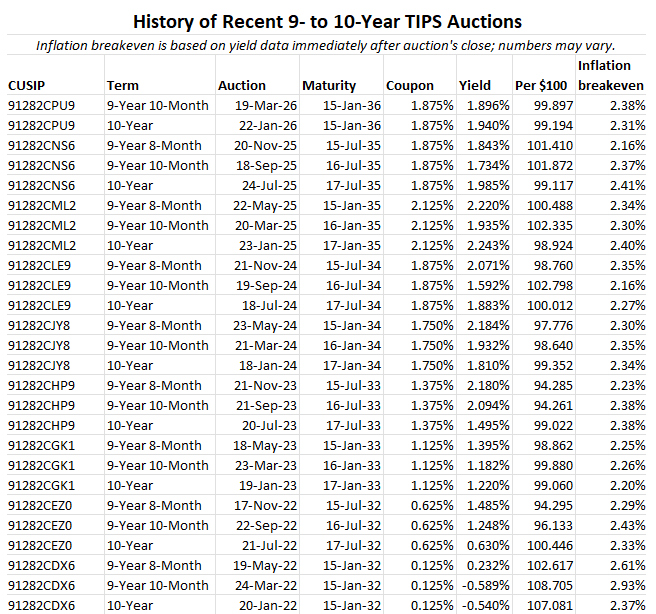
Here are results of recent TIPS auctions in the 4- to 5-year term. Note that just four years ago, a similar December reopening got a real yield of -1.508%. Things have changed for the better for TIPS investors:

Confused by TIPS? Read my Q&A on TIPS

TIPS in depth: Understand the language

TIPS on the secondary market: Things to consider

TIPS investor: Don’t over-think the threat of deflation

Upcoming schedule of TIPS auctions

—————————

Donate? This site is free and I plan to keep it that way. Some readers have suggested having a way to contribute. I would welcome donations. Any amount, or skip it, your choice. This is completely optional.

PayPal link / Venmo link

—————————

Follow Tipswatch on X for updates on daily Treasury auctions and real yield trends (when I am not traveling).

Feel free to post comments or questions below. If it is your first-ever comment, it will have to wait for moderation. After that, your comments will automatically appear. Please stay on topic and avoid political tirades. NOTE: Comment threads can only be three responses deep. If you see that you cannot respond, create a new comment and reference the topic.

David Enna is a financial journalist, not a financial adviser. He is not selling or profiting from any investment discussed. I Bonds and TIPS are not “get rich” investments; they are best used for capital preservation and inflation protection. They can be purchased through the Treasury or other providers without fees, commissions or carrying charges. Please do your own research before investing.
Posted in Inflation, Investing in TIPS, TreasuryDirect | Tagged , , | 12 Comments

U.S. annual inflation falls to 2.7% for November, a surprising drop

By David Enna, Tipswatch.com

In the messiest inflation report in history, the Bureau of Labor Statistics said today that seasonally-adjusted consumer prices rose just 0.2% over a two-month period (October and November), resulting in an annual rate of 2.7%

This is a two-month report because the BLS didn’t collect inflation data for October during the 43-day government shutdown. Plus, the November report was delayed by eight days. So we have been flying blind since the September report (also delayed) was issued on Oct. 24.

For what it is worth, this is a very encouraging inflation report, with both all-items and core inflation coming in well below expectations. The all-items annual rate fell from 3.0% to 2.7% and core inflation fell from 3.0% to 2.6%. This indicates a strong disinflationary trend. But the BLS did note:

BLS did not collect survey data for October 2025 due to a lapse in appropriations. BLS was unable to retroactively collect these data. For a few indexes, BLS uses nonsurvey data sources instead of survey data to make the index calculations. BLS was able to retroactively acquire most of the nonsurvey data for October. CPI data collection resumed on November 14, 2025.

This November report from the BLS was massively slimmed down and in most cases the bureau did not report month-over-month price changes because it had no data for October. This is surreal. For example, here is the very strange chart of annual CPI rates over the last year:

And here is the BLS’s slimmed-down list of month-over-month changes by category. There has never been an inflation report like this:

Honestly, I have nothing to say except: Let’s wait for December data, to be released on Jan. 13, hopefully on time.

What this means for TIPS and I Bonds

Investors in Treasury Inflation-Protected Securities and Series I Savings Bonds are also interested in non-seasonally adjusted inflation, which is used to adjust principal balances on TIPS and set future interest rates for I Bonds. Normally, this is a routine calculation, but not today.

The Treasury was required by federal regulations to create a non-seasonally adjusted CPI index for October, which was used to set inflation accruals for TIPS in December. That October number — resulting from a synthetic calculation averaging inflation over the previous 12 months — was 325.604, which I had suspected was too high.

For November, the BLS set the inflation index at 324.122, a whopping 0.46% less than the October number. So yes, the October number was artificial, and artificially too high.

For TIPS. This November inflation report means that principal balances for all TIPS will fall 0.46% in January, after rising 0.25% in December, which was artificially too high. Here are the new January Inflation Indexes for all TIPS.

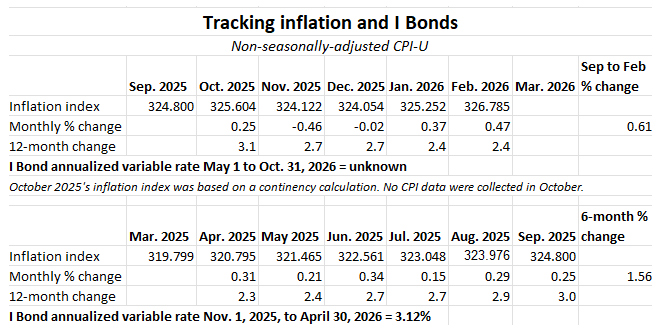
For I Bonds. The November report is the second of a six-month string that will set the I Bond’s new variable rate, to be reset on May 1, 2026. So far, two months in, inflation has declined 0.21%.

View historical data on my Inflation and I Bonds page.

It is very common for non-seasonally adjusted CPI to dip into deflation in the last three months of the year, especially in November and December. This trend will turn around in the January to March inflation periods.

What this means for future interest rates

Because this inflation report was so convoluted, it is suspect. I do trust the BLS, but it has been working in a very difficult situation over recent months. The November data could open the way for future rate cuts by the Federal Reserve, but as Bloomberg noted in this morning’s report:

Given the data distortions, investors shouldn’t read too much into this one data print. …

It’s possible that this does reflect a genuine drop off in inflationary pressures, but such a sudden stop, particularly in the more-persistent services components like rent of shelter is very unusual, at least outside of a recession. The upshot is that is looks like we all have to wait until the December data is published next month to verify whether this is a statistical blip or a genuine disinflation.

Inflation analyst Michael Ashton posted a blistering critique of this inflation report this morning. Listen to it here:

Normally, we could look at month-to-month data on food prices, medical care services, apparel, electricity, etc., but all of that is missing in this pared-down November inflation report. My conclusion is that our confusion is justified.

—————————

Donate? This site is free and I plan to keep it that way. Some readers have suggested having a way to contribute. I would welcome donations. Any amount, or skip it, your choice. This is completely optional.

PayPal link / Venmo link

—————————

Follow Tipswatch on X for updates on daily Treasury auctions and real yield trends (when I am not traveling).

Feel free to post comments or questions below. If it is your first-ever comment, it will have to wait for moderation. After that, your comments will automatically appear. Please stay on topic and avoid political tirades. NOTE: Comment threads can only be three responses deep. If you see that you cannot respond, create a new comment and reference the topic.

David Enna is a financial journalist, not a financial adviser. He is not selling or profiting from any investment discussed. I Bonds and TIPS are not “get rich” investments; they are best used for capital preservation and inflation protection. They can be purchased through the Treasury or other providers without fees, commissions or carrying charges. Please do your own research before investing.
Posted in Federal Reserve, I Bond, Inflation, Investing in TIPS, Savings Bond | Tagged , , , , , , | 24 Comments

This week’s 5-year TIPS auction still looks solid

AI generated photo. Source: Google Gemini.

By David Enna, Tipswatch.com

As I noted in a post last week, the Federal Reserve’s recent moves to lower short-term interest rates haven’t caused real yields to decline. Instead, they have been rising.

Normally, the 5-year real yield will track lower or higher to match the Federal Reserve’s rate decisions. The 5-year is the shortest term of auctioned TIPS and so its yield generally follows along with the Fed’s December decisions on short-term rates. But not this year. The 5-year real yield has increased 7 basis points since December 1 and 3 basis points since the Fed’s announcement on December 10.

All of this is leading up to Thursday’s offering of $24 billion in a reopened 5-year Treasury Inflation-Protected Security – CUSIP 91282CPH8 – creating a 4-year, 10-month TIPS. This TIPS has a coupon rate of 1.125%, set at the originating auction on Oct. 23, 2025, which generated a real yield to maturity of 1.182%.

CUSIP 91282CPH8 trades on the secondary market, where it closed Friday with a real yield of 1.40% and a price of 98.73. The price is discounted because the current real yield is higher than the coupon rate of 1.125%.

It’s important to point out that the real yield of this TIPS has increased 22 basis points in two months, during a time the Federal Reserve was cutting short-term interest rates by 50 basis points. That’s remarkable.

Definition: The “real yield to maturity” of a TIPS is its yield above official future U.S. inflation over the term of the TIPS. So a real yield of 1.40% means an investment in this TIPS would provide a return that exceeds U.S. inflation by 1.40% for 4 years, 10 months.

Is a real yield of 1.40% attractive? Historically, yes, but it is well below the high of about 2.51% set in October 2023. Here is the trend in the 5-year real yield over the last 15 years:

Click on image for larger version.

Pricing

CUSIP 91282CPH8 closed Friday with a price of 98.73, and it will carry an inflation index of 1.00653 on the settlement date of Dec. 31. With that information, we can estimate the cost of a $10,000 par value investment at Thursday’s auction.

  • Par value. $10,000.
  • Principal purchased on settlement date. $10,000 x 1.00653 =$10,065.30
  • Cost of investment. $10,065.30 x 0.9873 = $9,937.47
  • + accrued interest of about $23.95.

In summary, under current market conditions, on the settlement date the investor would pay about $9,937 for about $10,065 in principal. From then on, the investor would earn accruals matching U.S. inflation, plus a coupon rate of 1.125% on inflation-adjusted principal for 4 years, 10 months.

This is an estimate. The market pricing will change by Thursday, but this can give investors an idea of the likely outcome.

Inflation breakeven rate

With the 5-year Treasury note closing Friday with a nominal yield of 3.75%, this TIPS currently has an inflation breakeven rate of 2.35%, a bit below recent auctions of this term. It means this TIPS will outperform the nominal Treasury if inflation averages more than 2.35% over the next 4 years, 10 months. (I’d take that bet.)

Note, however, that non-seasonally adjusted inflation could be near zero or slightly negative for November and December. This is the normal pattern for non-seasonally adjusted inflation. Don’t be alarmed if you see that.

Here is the trend in the 5-year inflation breakeven rate over the last 15 years, showing the strong surge higher in 2022 and more recently, a slight dip:

Click on image for larger version.

Thoughts

One of the positives about a 5-year TIPS is: the term is short, and this auction’s 4-year, 10-month term is the shortest of any TIPS auction. Because of that short term, holding to maturity is easier, and this TIPS should be a good investment if held to maturity.

At the current real yield of 1.40%, it will outperform the U.S. Series I Savings Bond, which currently has a fixed rate of 0.9%. It also looks competitive versus best-in-nation 5-year bank CDs, currently yielding around 4.0%, which would push the breakeven rate up to 2.60%. The TIPS gets the advantage of protection against a surge in inflation.

I wouldn’t be surprised to see some rate volatility next week, so real yields could be rising or falling. CUSIP 91282CPH8 can also be purchased at any time on the secondary market.

The advantage of buying at auction, especially through TreasuryDirect, is that even small-lot purchases will get the auction’s high yield. The advantage of the secondary market is that you can see exactly the price and real yield you will be receiving. The negative is that you may face a small bid-ask spread. Most of the time, it doesn’t make a huge difference, but if you see a real yield you like, know that you can probably get it on the secondary market without dealing with the auction’s uncertainty.

Investors can track the market shifts for this TIPS in real time on Bloomberg’s Current Yields page. And here is advice for secondary market investors.

A couple of side notes about this auction:

  • The size of $24 billion is the largest in history for a 5-year TIPS reopening, up from $23 billion at the April reopening and $22 billion last December.
  • The inflation index of 1.00653 includes the result of the “synthetic” inflation calculation for October 2025. More on that here. Not a huge deal, but that number is almost certainly slightly off target. This will autocorrect as future inflation reports are issued, including the November report coming on Dec. 18.
  • For the first time I know of, this auction will close just a few hours after the release of the November inflation report, which was delayed from Dec. 10. That’s never happened before. The results of that report could influence the auction result.

This TIPS auction closes Thursday at 1 p.m. EST. Non-competitive bids at TreasuryDirect must be placed by noon Thursday. If you are putting an order in through a brokerage, make sure to place your order Wednesday or very early Thursday, because brokers cut off auction orders before the noon deadline.

I will be reporting the auction results soon after the auction’s close at 1 p.m. and of course I will be writing about the November inflation report, to be issued on the same day at 8:30 a.m. EST. Here are results for recent auctions of this 4- to 5-year term:

Confused by TIPS? Read my Q&A on TIPS

TIPS in depth: Understand the language

TIPS on the secondary market: Things to consider

TIPS investor: Don’t over-think the threat of deflation

Upcoming schedule of TIPS auctions

—————————

Donate? This site is free and I plan to keep it that way. Some readers have suggested having a way to contribute. I would welcome donations. Any amount, or skip it, your choice. This is completely optional.

PayPal link / Venmo link

—————————

Follow Tipswatch on X for updates on daily Treasury auctions and real yield trends (when I am not traveling).

Feel free to post comments or questions below. If it is your first-ever comment, it will have to wait for moderation. After that, your comments will automatically appear. Please stay on topic and avoid political tirades. NOTE: Comment threads can only be three responses deep. If you see that you cannot respond, create a new comment and reference the topic.

David Enna is a financial journalist, not a financial adviser. He is not selling or profiting from any investment discussed. I Bonds and TIPS are not “get rich” investments; they are best used for capital preservation and inflation protection. They can be purchased through the Treasury or other providers without fees, commissions or carrying charges. Please do your own research before investing.
Posted in Bank CDs, I Bond, Inflation, Investing in TIPS, TreasuryDirect | Tagged , | 14 Comments